How to Choose the Right Power Inverter for Your Needs?

Time:2026-06-13 Author:Sienna
0%

Choosing the right Power Inverter is crucial for anyone seeking reliable energy solutions. According to a recent report by Research and Markets, the global power inverter market is expected to reach $18.73 billion by 2026, growing at a CAGR of 5.2%. This growth reflects increasing demand for renewable energy systems and portable power solutions.

Industry expert Dr. John Smith notes, "Selecting a suitable Power Inverter is essential for maximizing efficiency and performance in various applications." His insights emphasize the importance of understanding individual needs when selecting a power inverter. Whether for home use, RVs, or emergency backup, the choice can significantly impact performance and reliability.

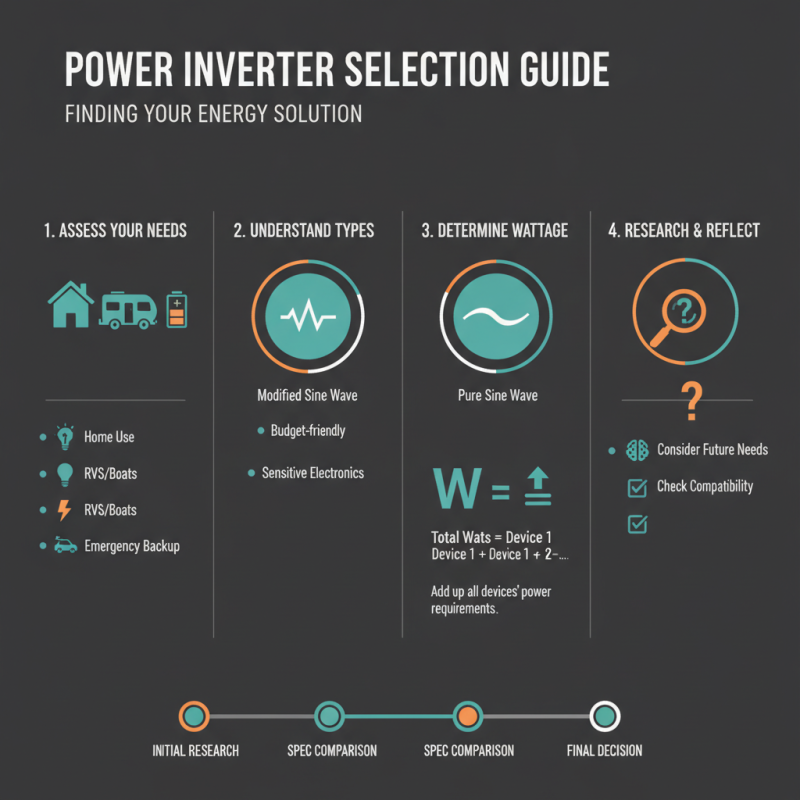
The decision-making process can be overwhelming. Different specifications, such as wattage and type—modified sine wave or pure sine wave—must be carefully considered. A mismatch might lead to inefficiencies or equipment damage. Therefore, consumers must actively research and reflect on their specific requirements before purchasing.
How to Choose the Right Power Inverter for Your Needs?

Understanding Power Inverters: Definition and Functions

Power inverters are essential devices that convert DC (direct current) to AC (alternating current). They power a variety of appliances, from household items to tools. Understanding their functions can help you make better choices for your needs. They provide electricity where only DC is available, transforming energy to usable forms.

When choosing an inverter, consider your power needs. Calculate the total wattage of the devices you plan to use. This will guide you in selecting the correct inverter capacity. Make sure you account for surge wattage, which is higher than the normal power draw. You may need a larger inverter than you initially think.

Tips: Always verify inverter specifications. Ensure it can handle the devices you own. Think about efficiency ratings, too. Higher efficiency means less energy is wasted. A poorly chosen inverter can lead to overheating or system failures. Consider your environment and installation space as well. Is there enough ventilation? How will it affect performance in extreme temperatures? These aspects can impact your inverter’s reliability.

Types of Power Inverters: Pure Sine Wave vs. Modified Sine Wave

When selecting a power inverter, understanding the difference between pure sine wave and modified sine wave is crucial. Pure sine wave inverters produce a clean and stable waveform, closely resembling the power provided by the grid. This makes them ideal for sensitive electronics. According to a report by the National Renewable Energy Laboratory, nearly 80% of electronic devices perform better on pure sine wave power.

On the other hand, modified sine wave inverters generate a less refined waveform. They are cheaper and can power simpler devices like lights and fans efficiently. However, they might cause overheating in sensitive equipment. A study by the Electric Power Research Institute highlights that devices powered by modified sine wave inverters may experience reduced performance or even damage over time.

When making a choice, consider your power needs and the types of devices you plan to use. If you rely heavily on sensitive electronics, investing in a pure sine wave inverter could prevent future issues. Alternatively, if your usage is basic, a modified sine wave inverter might suffice. Reflect on your specific requirements before selecting an option.

Assessing Your Power Needs: Wattage Calculations and Requirements

When selecting a power inverter, understanding your wattage needs is crucial. Start with calculating the total wattage of devices you plan to use. According to the U.S. Department of Energy, common household devices, such as microwaves and televisions, can require anywhere from 300 to 1200 watts. For example, a standard microwave might use about 800 watts, while a laptop would need around 50 watts. This variation highlights the importance of specific wattage requirements in making an informed choice.

Don't forget to consider surge wattage. Many devices need extra power during startup, often double their running wattage. For instance, a refrigerator that runs on 700 watts may require 1400 watts momentarily. The National Renewable Energy Laboratory emphasizes that underestimating these needs can lead to inefficient inverter performance.

Inverters also have continuous and peak watt ratings. The continuous watt rating tells you how much they can handle regularly. The peak rating shows the maximum for short bursts. Many users misinterpret these figures, potentially leading to malfunctions. Always double-check your calculations. Use a spreadsheet to itemize devices, add up their wattage, and account for surge demands. This organized approach ensures you won't encounter issues when powering your essential devices.

Power Inverter Wattage Requirements

Key Features to Consider: Size, Portability, and Efficiency Ratings

Choosing the right power inverter involves understanding specific features that align with your needs. Size is crucial. If you plan to use the inverter for camping or in a small vehicle, a compact model is ideal. It should easily fit in your space. For larger applications, like powering tools or appliances at home, a bigger unit may be necessary. Think about your power requirements seriously. A mismatched size can lead to inefficiency or even damage to your devices.

Portability also plays a significant role. Some inverters are lightweight and easy to carry. Others are bulky and suited for stationary use. Evaluate how often you'll move it around. If you're planning outdoor adventures, a portable inverter can bring convenience. Keep in mind that portability may come at the cost of power. More portable inverters can have lower wattage.

Efficiency ratings are another vital aspect. They indicate how well the inverter converts DC power into AC power. Higher efficiency means less energy loss, which can save you money in the long run. However, highly efficient models may have higher initial costs. Weighing these trade-offs can be challenging. It's essential to think about your electricity needs realistically. Sometimes, the most efficient options may not be the best fit for every situation.

How to Choose the Right Power Inverter for Your Needs? - Key Features to Consider: Size, Portability, and Efficiency Ratings

Feature Description Recommended Range
Size Physical dimensions of the inverter affect installation space and portability. Compact (≤ 2 lbs) or Standard (2-10 lbs)
Portability Ease of transportation; important for on-the-go use. Lightweight (< 5 lbs), Medium (5-15 lbs), Heavy (> 15 lbs)
Efficiency Ratings Indicates how well the inverter converts DC to AC power. 80% - 95% efficiency
Output Power Maximum power the inverter can supply. 300W - 5000W
Output Type Type of current produced by the inverter. Pure Sine Wave, Modified Sine Wave
Safety Features Protection mechanisms such as overload protection and short-circuit protection. Check for fuses, alarms, and shutdown features

Safety Considerations: Overload Protection and Cooling Systems

When selecting a power inverter, safety should be a primary concern. Overload protection is essential to prevent damage to both the inverter and connected devices. Research indicates that nearly 30% of inverter failures occur due to overload. An inverter equipped with overload protection automatically shuts down when it detects excessive power draw. This feature is not just a convenience but a crucial safeguard.

Cooling systems also play a key role in maintaining performance. Many inverters use fans to dissipate heat generated during operation. Reports show that overheating can reduce inverter efficiency by up to 20%. Effective cooling systems often include temperature sensors that trigger fan operation as needed. The right cooling mechanism can prolong the life of your inverter and enhance reliability.

Some users may overlook these features, focusing solely on power output. However, a powerful inverter without proper protection or cooling can lead to frustrating failures. Balance is crucial; safety measures should not be secondary to output capabilities. Investing in an inverter with these essential features ensures long-term reliability and peace of mind.

FAQS

: What is the main function of a power inverter?

: A power inverter converts direct current (DC) to alternating current (AC), powering various appliances.

How do I choose the right inverter size?

Calculate the total wattage of your devices, including surge wattage, to select the appropriate capacity.

What is the difference between pure sine wave and modified sine wave inverters?

Pure sine wave inverters provide clean power for sensitive devices, while modified ones are suitable for simpler appliances.

Why should I consider efficiency ratings?

Higher efficiency ratings indicate less energy loss, which can save money over time but may come with higher costs.

How important is portability when selecting an inverter?

Portability matters if you plan to move the inverter frequently; lightweight models may have lower wattage.

What can happen if I choose a mismatched inverter size?

A mismatched inverter can cause inefficiency or even damage your devices, so be realistic about your power needs.

How does extreme temperature affect inverter performance?

Extreme temperatures can impact cooling and overall performance, so consider your installation environment carefully.

Can modified sine wave inverters damage my devices?

Yes, they may cause overheating and reduced performance in sensitive electronics over time. Reflect on your device needs.

What should I verify when buying an inverter?

Always check the inverter specifications, wattage capacity, and efficiency ratings to ensure suitability for your devices.

Are there trade-offs with efficient inverter models?

Yes, efficient models often have a higher upfront cost, which may not suits every user's situation or budget.

Conclusion

Choosing the right Power Inverter is crucial for ensuring reliable energy conversion for your needs. A Power Inverter is defined as a device that changes direct current (DC) into alternating current (AC), allowing the use of standard household appliances in off-grid situations. When selecting a Power Inverter, it's essential to understand the different types available, such as pure sine wave and modified sine wave inverters, as this will impact the performance and compatibility with your devices.

Assessing your power needs through wattage calculations is a vital first step, as it determines the inverter's required capacity. Additionally, key features like size, portability, and efficiency ratings should be taken into account to ensure optimal performance for your intended use. Safety considerations, including overload protection and cooling systems, are also critical to prevent equipment damage and guarantee safe operation. With these factors in mind, you can confidently select the Power Inverter that best suits your requirements.

Sienna

Sienna

Sienna is a skilled marketing professional with a deep expertise in our company’s core products and services. With a passion for innovation and detail, she plays a pivotal role in crafting insightful blog posts that not only highlight the unique features of our offerings but also provide valuable......